
Practical Guide to Acquiring Goods, Services, and Paying Bills, Rent, Fees, Fares, Fines Without Paying with Cash
You don’t need money in your account to get what you need. You need value — and JummikPurse knows how to move it.
A New Way to Acquire What You Need
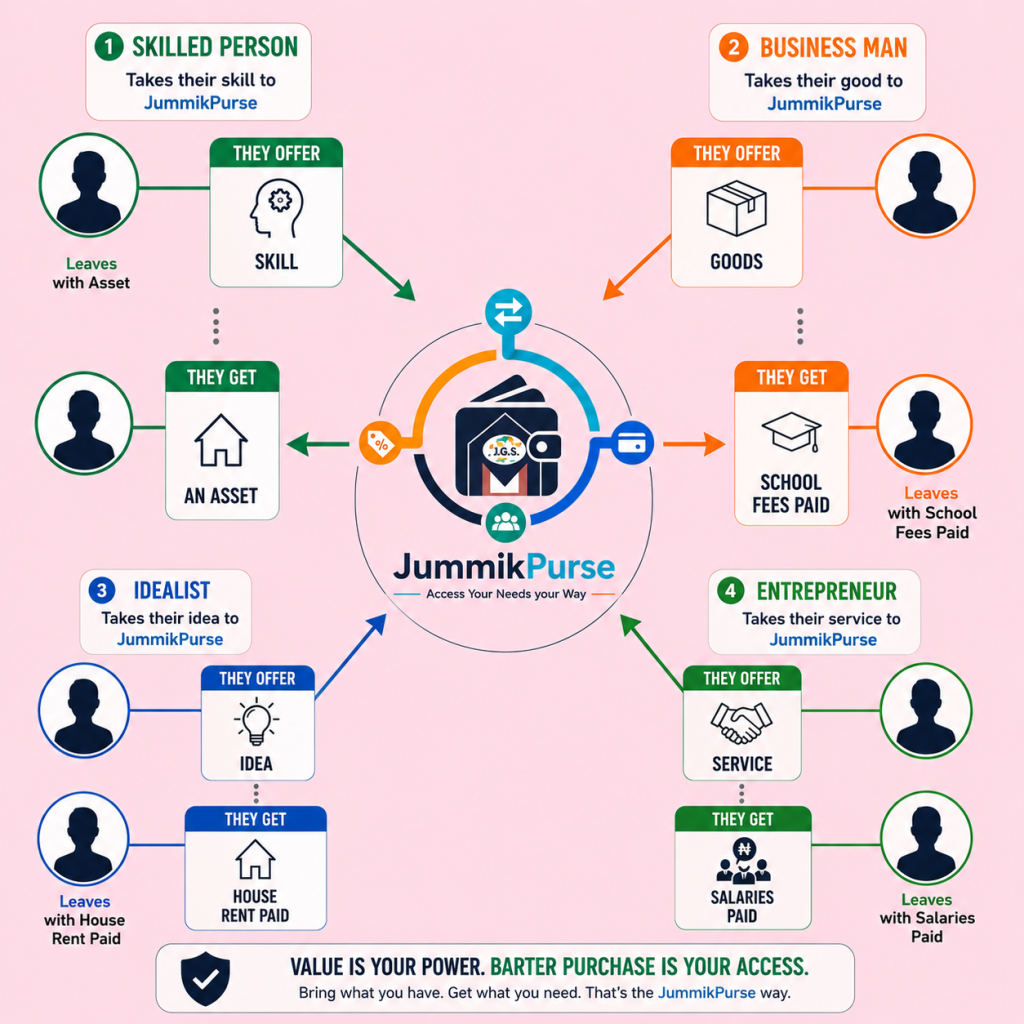
Before money existed, civilizations thrived through barter. Jummikplus didn’t invent Barter. It gave Barter an Official Purse.
For centuries, before Naira, before coins, before paper money of any kind, people exchanged what they had for what they needed. A farmer traded grain for cloth. A blacksmith traded tools for livestock. Value moved from hand to hand without ever needing a currency to validate it. Somewhere along the way, formal economies decided that money — and only money — could represent value. Barter was pushed aside as primitive, informal, something markets had “outgrown.”
We at JummikPurse disagree. We believe value never stopped being valuable — it simply lost its official system for exchange. That’s what the Barter Purchase Service restores: a formal, structured, nationwide way for Nigerians to acquire goods, assets, rentals, professional services, and even pay bills, fees, fares, and fines, using what they already have instead of what they don’t.
This article is your complete foundational guide to Barter Purchase on JummikPurse.
Why Nigeria Needs a Formal Barter System
The Real Problem Isn’t a Lack of Value — It’s a Lack of Liquidity
Across Nigeria, from the stalls of Balogun Market in Lagos to the workshops of Ariaria Aba, from the grain sellers of Onitsha Main Market to the tailors and technicians of Kaduna and Kano, value is everywhere. Skills are everywhere. Property, produce, and expertise sit idle every single day — not because they lack worth, but because there’s no cash-at-hand to convert them into what someone needs right now.
Millions of Nigerians face this same wall: a skill they can’t monetise quickly, an asset they can’t liquidate fast enough, a service they could render in exchange for something — but no system exists to make that exchange formal, trackable, or fair. Barter Purchase closes that gap.
Cash-at-Hand vs. Value-at-Hand
We draw a clear distinction: cash-at-hand is what’s currently sitting in your account or your pocket. Value-at-hand is everything else you possess that’s worth something — your time, your skill, your goods, your property. Barter Purchase treats these as equally valid tools for acquisition.
Traditional Barter vs. Barter Purchase: What’s Different
Barter Trade Is Informal. Barter Purchase Is Structured.
Traditional barter — trading a bag of rice for a bag of beans, or labour for livestock — happens between two people, on the spot, with no formal record, no standard measure of value, and no third party to mediate disputes.
Barter Purchase is different. It is a formally rendered service, delivered through JummikPurse, with standardised value units, documented transactions, and Agents who facilitate the process from request to completion. At the time of this publication, Jummikplus Global Services is the first and only organisation rendering Barter Service officially and formally, worldwide.
From Two-Party Swaps to a Purchasing Infrastructure
Old-style barter required both parties to want exactly what the other had — a limitation economists call the “double coincidence of wants.” Barter Purchase removes that limitation. Through JummikPurse, your value doesn’t need to match one specific person’s need. It enters a structured system where it can be assessed, converted, and applied toward whatever you’re trying to acquire.
Understanding the Barter Value System: Baterium and Barteria
Baterium: The Primary Unit of Barter Value
Just as Naira is the standard currency of Nigeria, Baterium is the standard unit of value within the Barter Purchase Service. It is how JummikPurse measures and records the worth of what you bring to the table — your skill, your goods, your time, your property.
Barteria: The Fractional Unit
Just as Naira breaks down into Kobo, Baterium breaks down into Barteria. This allows for precise value calculation, so that even smaller contributions of skill or goods can be accurately measured and applied.
In comparison:
| Cash Currency | Barter Currency |
|---|---|
| Dollar / Naira | Baterium |
| Cent / Kobo | Barteria |
Why a Standard Unit Matters
Without a standard unit, barter collapses back into informal guesswork — “is my goat worth your ten bags of rice?” Baterium and Barteria give Barter Purchase the same precision and trust that Naira gives cash transactions.
JummikPurse: The Official Purse for Barter Purchase
What Is JummikPurse?
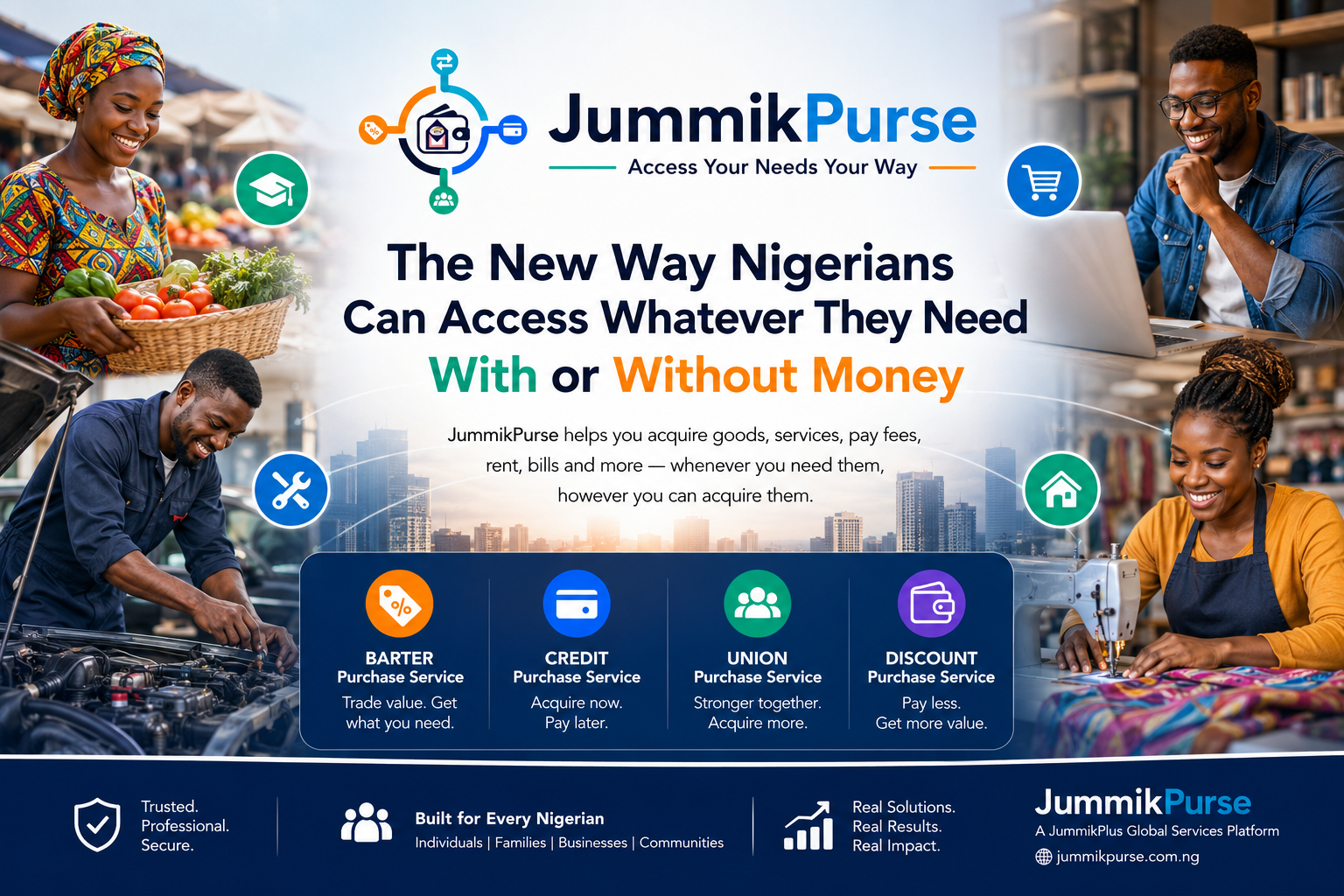
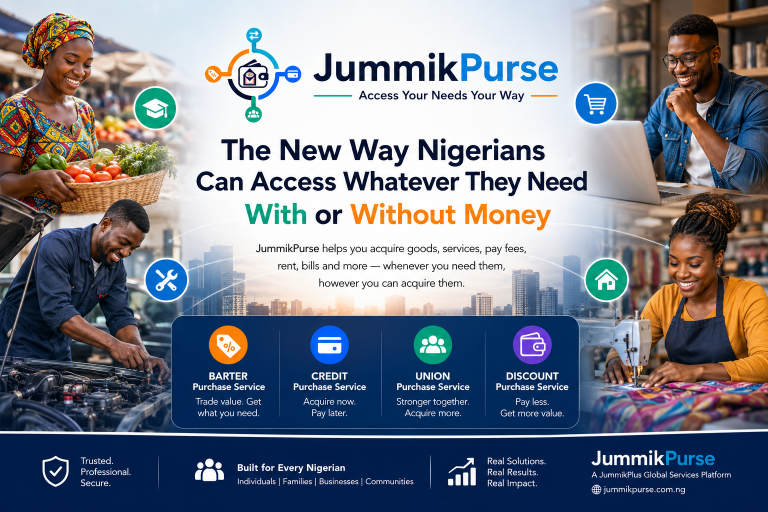
JummikPurse is Jummikplus Global Services’ official ecosystem for Purchase Management and Value Exchange — built to help Nigerians acquire whatever they need, whenever they need it, whether or not they currently have money. This is achieved through Barter Purchase, Credit Purchase, Union Purchase and Discount Purchase Service
Barter Purchase as One of Four Acquisition Pathways
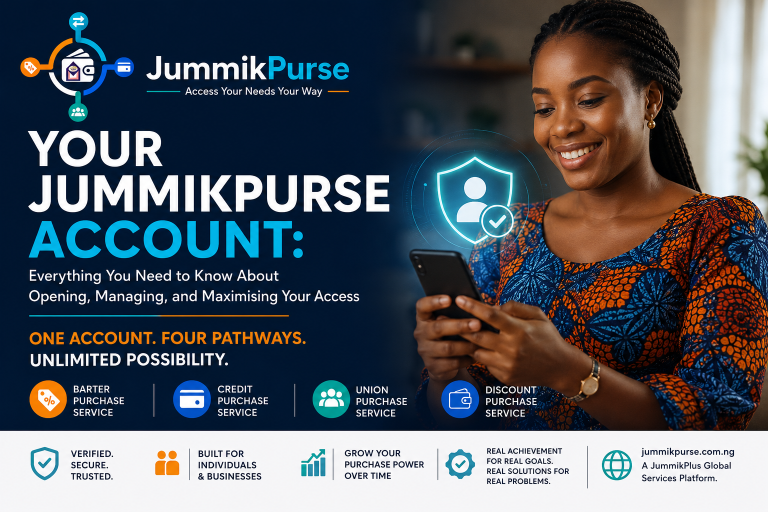
Barter Purchase is one of four structured ways JummikPurse enables acquisition:
- Barteram — Barter Purchase (value-for-value)
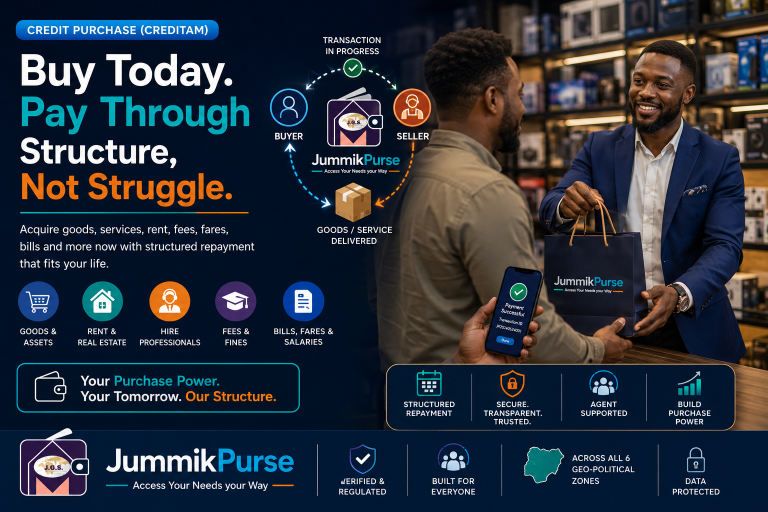
- Creditam — Credit Purchase (buy now, structured repayment)
- Unionam — Union Purchase (pooled contribution)
- Discountam — Discount Purchase (reduced-cost acquisition)
This article focuses on Barteram — the Barter Purchase pathway — but it’s worth knowing it operates alongside three other models, giving Nigerians more than one route to the same destination: getting what they need.
The Role of Agents
JummikPurse Agents are deployed across Nigeria to facilitate Barter Purchase transactions — assessing value, guiding clients through the process, and ensuring every exchange is handled fairly and formally.
Who Can Use Barter Purchase?
Individuals and Everyday Nigerians
Anyone with a skill, service, idea, information or asset to offer can access Barter Purchase — no formal business registration required. Just a JummikPurse Account.
Businesses and SMEs
Small and medium businesses across all six geopolitical zones — North Central, North East, North West, South East, South South, and South West — can use Barter Purchase to acquire inventory, equipment, or services without depleting working capital.
Persona: Adaeze in Onitsha
Adaeze runs a small provisions stall near Onitsha Main Market. Business is steady but cash flow is tight this quarter. Through Barter Purchase, she offers her market-day labour and product supply relationships in exchange for restocking credit — no loan, no cash-at-hand required.
Persona: Musa in Kaduna
Musa is a civil servant whose salary hasn’t cleared, but school resumption is two weeks away. Through Barter Purchase, he offers his weekend tutoring skills in exchange for his children’s school fees being settled.
Persona: Chinedu in Ariaria Aba
Chinedu is a skilled shoemaker. Rather than wait for cash sales to accumulate, he uses Barter Purchase to acquire raw leather and tools by offering finished products and his craftsmanship directly into the system.
What Can Be Acquired Through Barter Purchase
Goods and Everyday Items
From food items to electronics to household goods — Barter Purchase covers the acquisition of tangible goods.
Assets
Barter Purchase extends to acquiring larger assets — equipment, vehicles, and other property — using value instead of a lump cash sum.
Real Estate and Rentals
This is one of the most powerful applications: renting anything, including real estate. Whether it’s a shop space, an apartment, or office premises, Barter Purchase can facilitate the rental process through value exchange.
Hiring Professionals
Need a technician, a consultant, a tutor, or a tradesperson? Barter Purchase allows you to hire professional services without cash payment.
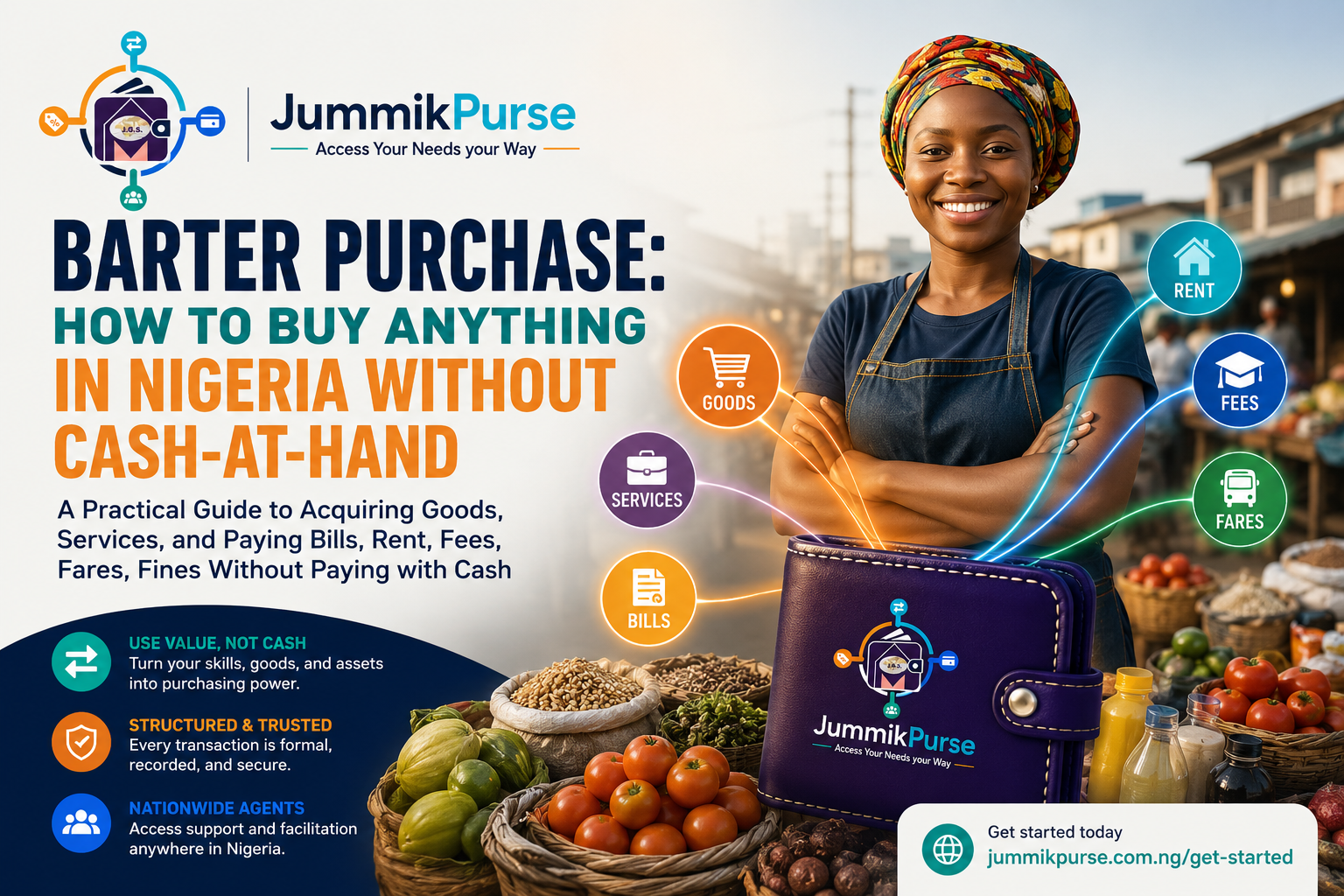
Paying Bills, Fees, Fares, Fines, and Salaries
Barter Purchase isn’t limited to physical goods. It extends to some of the most pressing cash-dependent obligations Nigerians face daily:
- Bills — utility and service payments
- Fees — school fees and other institutional charges
- Fares — transport costs
- Fines — regulatory or institutional penalties
- Salaries — wage payments facilitated through value exchange
How Barter Purchase Works: Step-by-Step
Step 1: Create Your JummikPurse Account
Every Barter Purchase journey begins with a registered JummikPurse account, which becomes your access point for all four acquisition pathways.
Step 2: Declare Your Value
You present what you have to offer — a skill, goods, property, or service — for assessment.
Step 3: Value Assessment in Baterium and Barteria
A JummikPurse Agent evaluates your offering and converts it into its equivalent in Baterium and Barteria.
Step 4: Submit Your Purchase Request
You specify what you want to acquire — whether it’s a good, a rental, a service, or a bill payment — and your Baterium balance is applied.
Step 5: Transaction Completion
JummikPurse facilitates the exchange, confirms delivery or fulfilment, and updates your Barter Purchase record.
Benefits of Barter Purchase
For Individuals
- Access goods and services without needing cash-at-hand
- Convert idle skills and assets into real purchasing power
- Meet urgent obligations like fees, rent, and bills without loans
For Businesses
- Preserve working capital while still acquiring inventory or services
- Build relationships within a structured, trustworthy exchange system
- Access professional services without cash cost pressure
For the Economy
- Formalises a practice that already happens informally across Nigerian markets
- Creates a nationwide record of value exchange, adding structure to an unstructured space
- Extends purchasing power to Nigerians who are asset-rich but cash-poor
Common Misconceptions About Barter Purchase
“It’s Just Old-Style Trading Rebranded”
Not quite. Traditional barter requires a direct match between two parties. Barter Purchase, through JummikPurse, removes that requirement entirely by using Baterium and Barteria as an intermediary value system.
“It Only Works for Goods”
As shown above, Barter Purchase extends well beyond goods — into rentals, professional services, bills, fees, fares, fines, and even salaries.
“It’s Informal and Untraceable”
Every Barter Purchase transaction on JummikPurse is formally facilitated and recorded — a key difference from casual barter arrangements.
Frequently Asked Questions
1. What is Barter Purchase on JummikPurse?
It is a formally structured service that allows individuals and businesses to acquire goods, services, rentals, and pay bills, fees, fares, and fines using value instead of cash.
2. What are Baterium and Barteria?
Baterium is the primary unit of barter value, comparable to Naira or Dollar. Barteria is its fractional unit, comparable to Kobo or Cent.
3. Do I need cash to start using Barter Purchase?
No. Barter Purchase is specifically designed for situations where you have value — skill, goods, property, or service — but not cash-at-hand.
4. Can businesses use Barter Purchase?
Yes. Businesses and SMEs across all six geopolitical zones can use Barter Purchase to acquire inventory, equipment, and services.
5. How do I get started?
You create a JummikPurse account, declare your value, and a JummikPurse Agent will guide you through assessment and your first Barter Purchase transaction.
Getting Started
Barter didn’t disappear when money arrived — it simply lost its official Purse. JummikPurse has given it one back.
If you have value to offer — a skill, a service, goods, or property — and a need to meet, Barter Purchase gives you a formal, trusted way to make that exchange happen, anywhere in Nigeria.
Create your JummikPurse account today at jummikplus Agent point nearest to you or Click Here to apply and put your value to work.